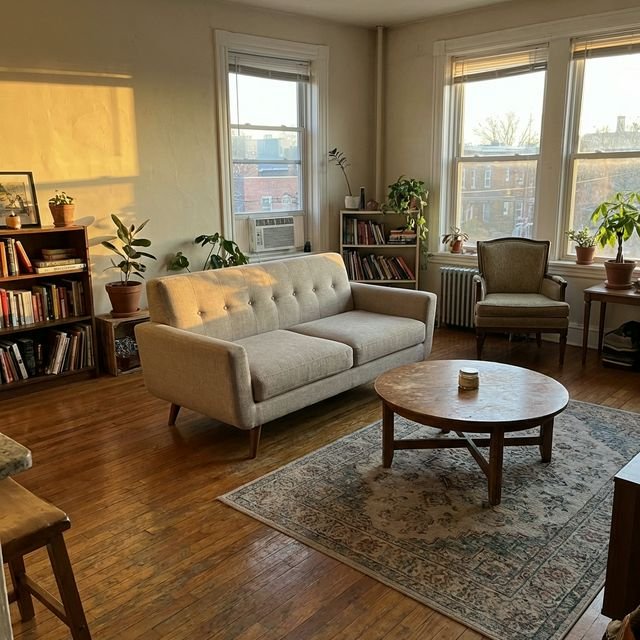
Living Room Refresh Checklist: 15 Steps to a Room That Feels New (Under $200)
You don’t hate your living room. You’re just… tired of it.
The pillows are flat. The lighting feels wrong. There’s a vague “something’s off” energy that you can’t quite name — but you notice it every time you walk in.
Good news: you don’t need to buy a new couch or repaint the entire room. Most living rooms are one afternoon and under $200 away from feeling completely different.
This checklist gives you 15 specific steps — in order of impact — that transform a stale living room into a space you actually want to spend time in. Most steps cost $0. The expensive ones are optional.
📌 Scroll to the bottom for a printable version of this checklist.
The 3-Phase System: Declutter → Rearrange → Restyle
Before we get into the 15 steps, here’s the structure. A living room refresh works best in three phases:
- Phase 1: Subtract (Steps 1-4) — Remove what’s dragging the room down. Free.
- Phase 2: Move (Steps 5-8) — Rearrange what you already own. Free.
- Phase 3: Add (Steps 9-15) — Bring in a few intentional upgrades. $50-200.
Most people skip straight to Phase 3 — they buy new stuff and pile it on top of the old stuff. That’s why it never feels “done.” Start with subtraction.
Phase 1: Subtract (Free)
Step 1: The 5-Minute Flat Surface Sweep ($0)
Walk through your living room and clear every flat surface — coffee table, side tables, console, bookshelf tops. Remove everything. Put it all in a box.
Now look at the room.
It already feels different, doesn’t it? Most living rooms have 40-60% more stuff on surfaces than they need. Clutter makes a room feel small, busy, and tired — even if each individual item is fine.
What goes back: Only things that are beautiful OR functional. Not both is fine; neither is the problem.
Step 2: Audit Your Throw Pillows ($0)
Pull every pillow off your sofa and chairs. Lay them on the floor and look at them honestly:
- Are any flat, lumpy, or stained? → Trash or donate
- Do they all match too perfectly? → That’s actually a problem (more on this in Step 10)
- Are there too many? → 3-5 pillows on a standard sofa is the sweet spot
- Do they still match your current style? → If you bought them 3+ years ago, probably not
Don’t buy replacements yet — that’s Step 10. For now, just edit down to the best ones.
Step 3: Check Your Lighting Situation ($0)
Stand in your living room at night with all your current lights on. Ask:
- Is the only light source overhead? → That’s the problem
- Is the lighting warm or cool? → Cool lighting makes rooms feel sterile
- Can you see any bare bulbs? → That’s visual noise
The single biggest atmosphere upgrade in any room is layered, warm lighting. You’ll fix this in Step 7.
Step 4: Remove One Piece of Furniture ($0)
This sounds extreme, but hear me out. Most living rooms have one piece of furniture that isn’t earning its keep — an end table nobody uses, an ottoman that’s become a laundry pile, a bookshelf that’s really just a junk shelf.
Take one piece out. Move it to another room or the garage for a week. If the living room immediately feels more open and you don’t miss it — it was the problem.
Phase 2: Move (Free)
Step 5: Pull Furniture Away from the Walls ($0)
This is the single most-repeated advice from interior designers, and most people ignore it because it feels counterintuitive in a small room.
Pull your sofa 4-6 inches away from the wall. Even 3 inches helps. Same with accent chairs. The gap creates depth — the room instantly feels more intentional, like someone designed it rather than just pushed everything to the edges.
If you have a rectangular room, try angling the sofa perpendicular to the longest wall instead of against it. It creates two zones and makes the room feel wider.
For more layout strategies, see our small living room layout guide with floor plans.
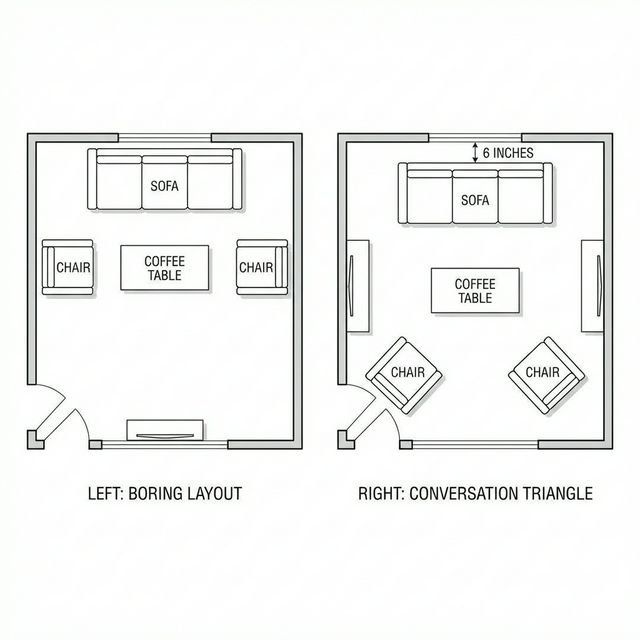
Step 6: Create a Conversation Triangle ($0)
Arrange your seating so that people sitting down can make eye contact without turning their heads more than 45 degrees. This is called a “conversation grouping” and it’s what separates a living room from a waiting room.
The basic setup:
- Sofa facing two chairs (or sofa + two chairs at angles)
- Coffee table in the center, within arm’s reach of every seat
- Side table next to at least one seat for drinks
Step 7: Rethink Your Lighting Layout ($0)
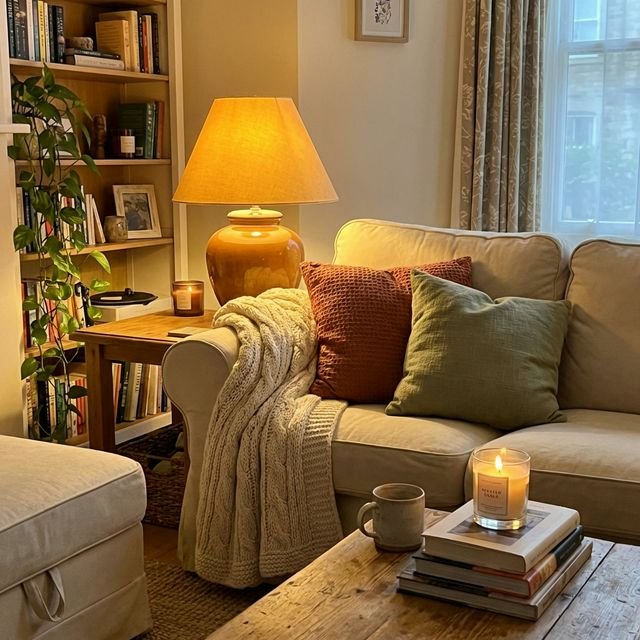
Move your existing lamps to create three layers of light:
- Ambient: One floor lamp or large table lamp for overall glow
- Task: One reading lamp near a seating area
- Accent: A candle, string lights, or lower-positioned lamp for warmth
The rule: no single overhead light should be your only source. If your rooms rely on ceiling fixtures, add one table or floor lamp. It changes everything.
Step 8: Rotate Your Books and Shelf Items ($0)
If you have bookshelves or open shelving, do a quick edit:
- Turn some books spine-out, some face-out (face-out books act as “art”)
- Group items in clusters of 3 (one tall, one medium, one small)
- Add one organic item per shelf — a plant cutting in a glass, a small stone, a piece of driftwood
- Leave some empty space. Breathing room makes shelves look styled, not stuffed.
Phase 3: Add ($50-200)
Now — and only now — you add new things. But only specific things, and only in this order (highest impact first).
Step 9: Swap Your Light Bulbs for Warm White ($8)
Replace every bulb in your living room with 2700K warm white. This is the single highest-ROI purchase in home decor. A 6-pack runs about $8 at Home Depot or Amazon.
What it does: Removes the “fluorescent office” feeling instantly. Everything in the room looks warmer, softer, and more inviting.
The number to remember: 2700K. That’s the warm, golden tone. Anything above 4000K is too cool for a living room.
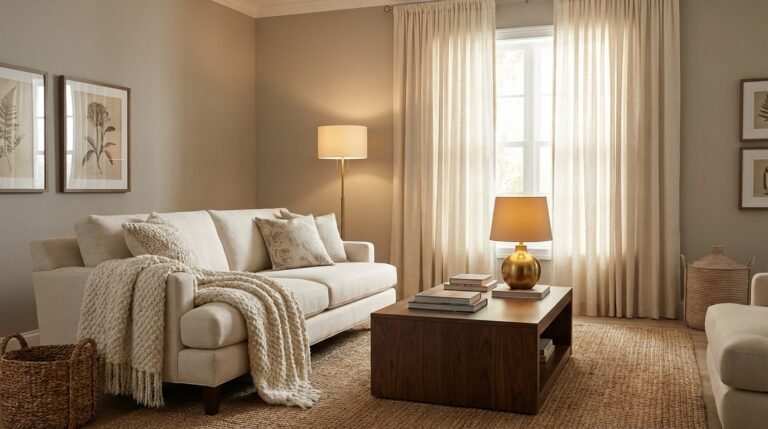
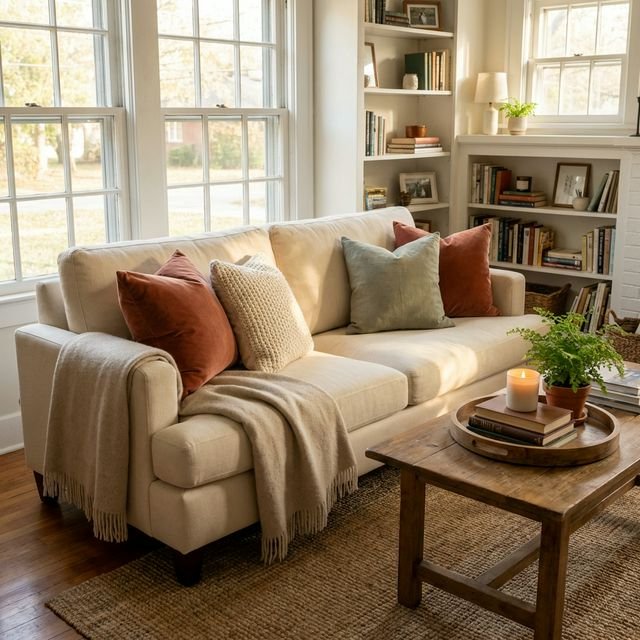
Step 10: New Throw Pillows — But With a Formula ($20-40)
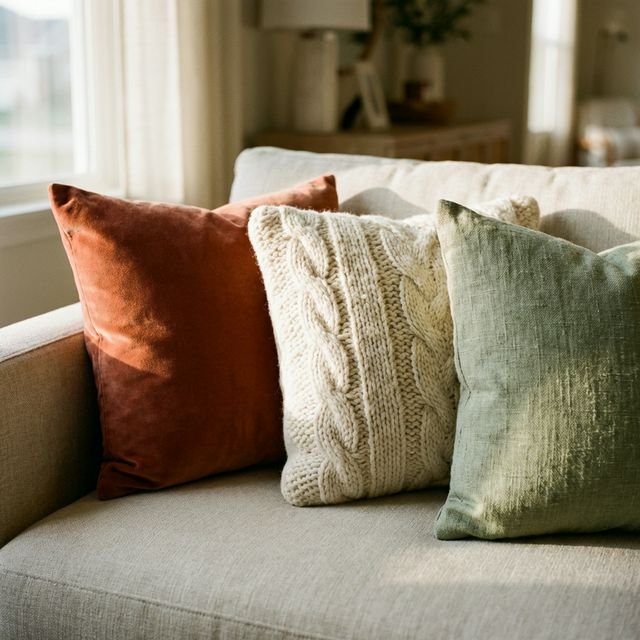
Remember the pillow audit from Step 2? Now it’s time to upgrade. But don’t just grab anything that looks nice — use the 3-texture formula:
Pick 3 pillows in the same color family but different textures:
- One velvet (rich, formal)
- One knit or woven (cozy, casual)
- One linen or cotton (clean, simple)
Same color family + different textures = a sofa that looks styled, not matchy-matchy.
Budget: $20-40 for pillow covers only (keep your inserts). Amazon and IKEA have great options.
If you want to go deeper on the cozy factor, our cozy living room ideas on a budget guide has 15 more ideas — all under $50.
Step 11: One Throw Blanket, Draped Right ($15-25)
A throw blanket does three things: adds color, adds texture, and makes a sofa look “designed.” But how you drape it matters:
- Over one arm (not folded on the back) — looks casual and inviting
- Casually tossed over one corner — the “just been used” look
- Never folded in a perfect rectangle on the center cushion — that’s a hotel lobby, not a home
Pick: Chunky knit for cozy vibes, lightweight linen for warm-weather rooms.
Step 12: Style Your Coffee Table ($10-20)
The coffee table is the visual center of your living room. If it’s cluttered with remotes, mail, and random cups — the whole room suffers.
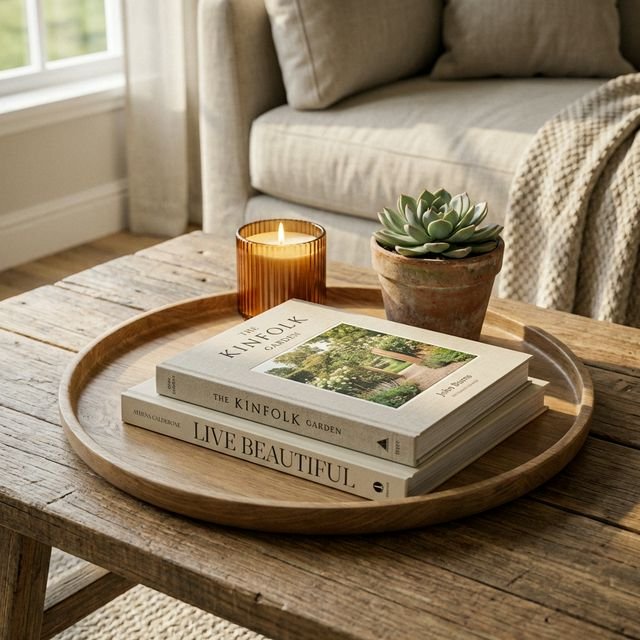
The coffee table formula (a tray + 3 items):
- A tray to contain everything (wood, brass, or marble — $8-15 at Target)
- A stack of 2-3 books (bonus: face the prettiest cover outward)
- A candle (warm scent — vanilla, cedar, or amber)
- A small plant or tiny vase with one stem
That’s it. Four things. On a tray. Your coffee table now looks like a magazine shoot for under $20.
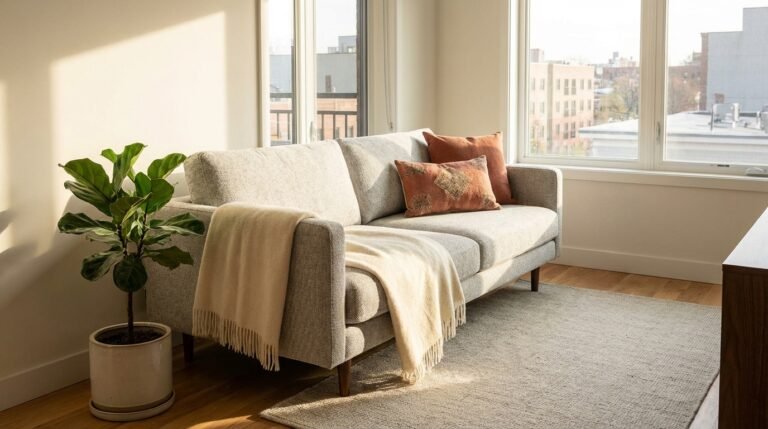
Step 13: Add One Plant ($8-15)
One living plant in $8 pot transforms a room from “nice” to “alive.” It adds color, texture, height, and visual interest — and unlike a pillow, it changes a little every week.
Best low-maintenance picks:
- Pothos ($6-10) — trailing, dramatic, nearly impossible to kill
- Snake plant ($10-15) — architectural, tolerates low light and neglect
- ZZ plant ($12-18) — glossy, modern, thrives on being ignored
Put it in the corner that feels emptiest. Every room has one.
Step 14: Swap or Add One Piece of Hardware ($5-12)
This is a secret weapon that costs almost nothing. Replace:
- Cabinet pulls on a console table or bookshelf with brass or matte black hardware
- Lamp finials (the little knob on top of the shade) with updated ones
- Curtain rod holders if they’re dated
A bag of brass cabinet pulls costs $8-12 for a 10-pack. Swapping them takes 5 minutes with a screwdriver. The room reads “updated” and most people can’t pinpoint why.
This technique works especially well with Neo Deco brass accents if you’re leaning into that trend.
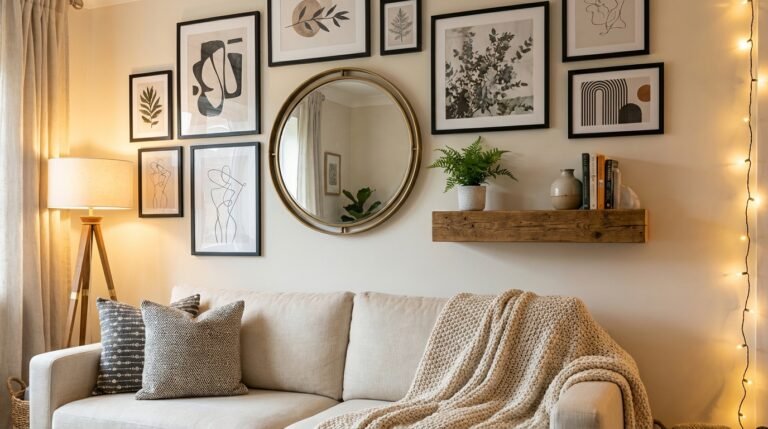
Step 15: One Piece of Wall Art or Mirror ($15-30)
If your walls are bare — or worse, still have the same poster from 3 years ago — one updated piece makes the room feel intentional.
Options by budget:
- Printable art from Etsy ($5-10 for a digital download) — print at Staples/Walgreens for $5
- Oversized mirror (IKEA LOTS mirrors, 4-pack for $10) — makes the room feel larger
- One statement piece (Target, HomeGoods, or TJ Maxx) — $15-25 for framed prints or canvases
The rule: hang art at eye level (57-60 inches from the floor to center). Most people hang too high.
The Living Room Refresh Budget Breakdown
| Step | Item | Cost |
|---|---|---|
| 1-8 | Declutter, rearrange, edit | $0 |
| 9 | Warm light bulbs (6-pack) | $8 |
| 10 | Throw pillow covers (3) | $20-40 |
| 11 | Throw blanket | $15-25 |
| 12 | Coffee table tray + candle + plant | $18-30 |
| 13 | One plant in simple pot | $8-15 |
| 14 | Hardware swap (pulls or finials) | $5-12 |
| 15 | Wall art or mirror | $15-30 |
| TOTAL | $89-160 |
Under $200 — with money to spare. And that’s if you do every step. Steps 1-8 are free and handle about 60% of the transformation on their own.
If you’re ready to expand this approach to your whole home, see our budget home makeover under $500 — room by room plan.
Before & After: What This Checklist Actually Does
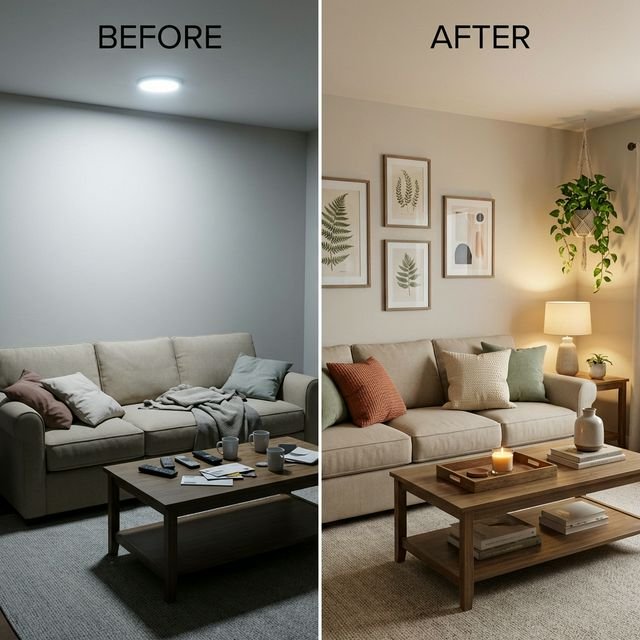
To see the full impact, picture the same room:
Before:
- Sofa pushed against the wall, pillows flat and mismatched
- One overhead light (cool white)
- Coffee table covered in remotes, mail, half-empty glasses
- Bare walls, no plants
After the 15-step checklist:
- Sofa pulled forward with a conversation grouping
- Three layers of warm lighting (floor lamp + table lamp + candle)
- Fresh pillows in coordinating textures, a draped throw
- Coffee table styled with a tray, books, candle, and plant
- One piece of wall art hung at the right height
- A pothos trailing from the empty corner
Same furniture. Same room. Completely different energy. Total spent: ~$120.
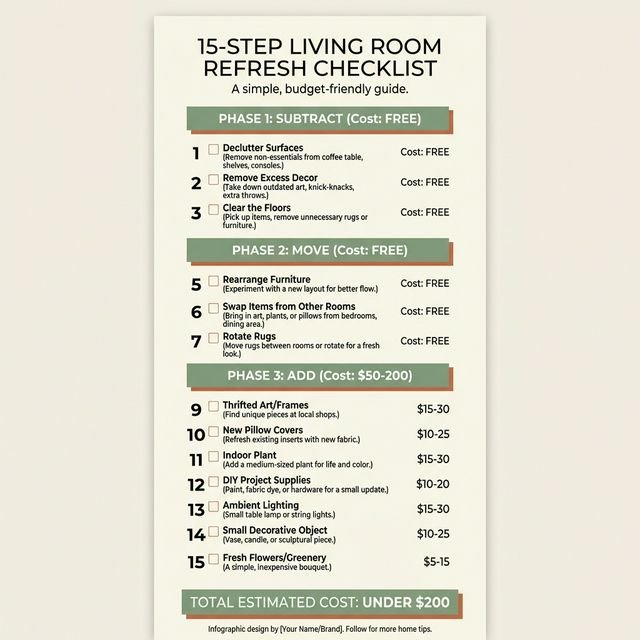
Your Printable Refresh Checklist
Save this version for your weekend project:
- ☐ Clear all flat surfaces (5 min)
- ☐ Audit throw pillows — edit down (10 min)
- ☐ Check lighting — identify what’s wrong (5 min)
- ☐ Remove one non-essential furniture piece (10 min)
- ☐ Pull furniture away from walls (15 min)
- ☐ Create conversation triangle seating (15 min)
- ☐ Move lamps into 3-layer lighting layout (10 min)
- ☐ Rotate books + edit shelves (15 min)
- ☐ Swap light bulbs to 2700K warm ($8)
- ☐ New throw pillow covers — 3-texture formula ($20-40)
- ☐ Add one draped throw blanket ($15-25)
- ☐ Style coffee table with tray + 3 items ($18-30)
- ☐ Add one living plant ($8-15)
- ☐ Swap hardware — brass or matte black ($5-12)
- ☐ Hang one piece of art at eye level ($15-30)
Total time: One afternoon | Total cost: Under $200
📌 Save this checklist — it works every time you need a refresh.
Frequently Asked Questions
How can I make my living room look better without buying new furniture?
Most living room energy comes from arrangement, lighting, and accessories — not the furniture itself. Start by pulling furniture away from walls, adding warm 2700K light bulbs, and restyling your coffee table. These three changes cost under $30 and shift the entire feel of a room.
What is the cheapest way to refresh a living room?
The cheapest way is to subtract: declutter surfaces, remove one piece of furniture you don’t need, and rearrange what’s left into a conversation grouping (Steps 1-8 in our checklist). Total cost: $0. Total time: about an hour.
What makes a living room feel cozy?
Five things: warm lighting (2700K bulbs, no harsh overhead), layered textures (mix velvet, knit, and linen), a well-styled coffee table, at least one living plant, and seating arranged for conversation. None of this requires expensive furniture.
How often should you refresh your living room?
A light refresh (our 15-step checklist) works great every 6-12 months. Seasonal swaps — switching throw blankets and pillow covers — keep things feeling new between bigger refreshes.
What color throw pillows should I get?
Choose pillows in the same color family but different textures. A good universal combo: one terracotta velvet, one cream knit, one sage linen. This works with almost any neutral sofa color. Avoid matching your sofa color too closely — contrast is what creates visual interest.
What to Read Next
- 📖 Cozy living room ideas on a budget — 15 more upgrades under $50
- 📖 Small living room layout ideas — floor plans for every shape
- 📖 Budget home makeover under $500 — room by room
- 📖 Home decor trends 2026 — what’s worth trying
📌 Pin this checklist for your next weekend refresh project!