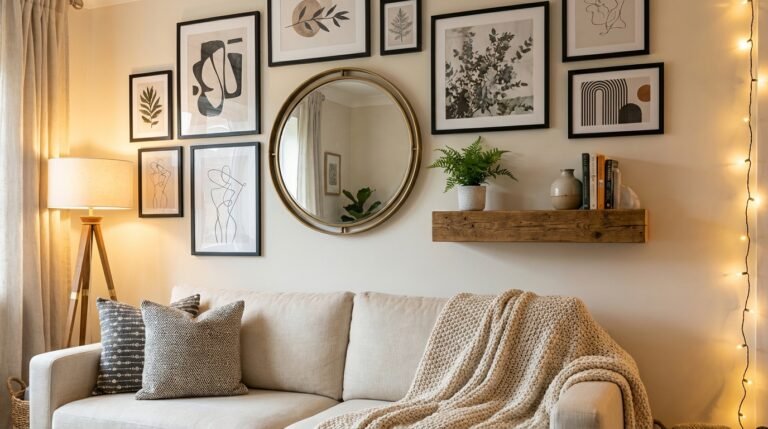
Small Living Room Layout Ideas: 8 Floor Plans That Actually Work
The problem with most “small living room ideas” articles? They show stunning rooms that are secretly 400 square feet.
Let’s talk about ACTUALLY small rooms — the 100-to-200-square-foot living rooms where the sofa barely fits and the coffee table blocks the walkway.
The fix isn’t smaller furniture (usually). It’s smarter placement.
This guide gives you 8 specific layouts matched to common small room shapes, with bird’s-eye floor plan diagrams so you can see exactly where everything goes. Find your room shape, copy the layout, and your room will feel bigger by dinner.
📌 Not sure which shape your room is? Scroll to the Room Shape Finder below.
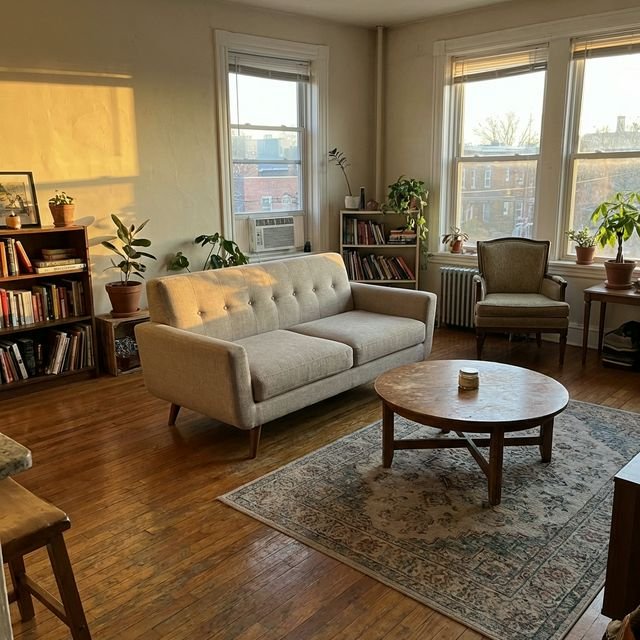
3 Golden Rules for Any Small Living Room Layout
Before we get into specific room shapes, these three rules apply to every small living room. Follow them regardless of which layout you choose.
Rule 1: Float Your Furniture
Pull your sofa 4-6 inches away from the wall. Even 3 inches helps.
This sounds wrong — “won’t I lose space?” — but the gap between furniture and wall creates a visual depth illusion. The room reads as larger because the eye sees layers, not a flat wall of stuff.
Interior designers call this “floating furniture” and it’s the #1 piece of advice for small rooms.
Rule 2: Create Zones, Not Rows
Even in a tiny room, define a “seating zone” versus a “walking zone.” Your furniture shouldn’t line the perimeter like chairs at a middle school dance.
A seating zone means: sofa and chairs facing each other with a coffee table in between, pulled together into a grouping — even if that grouping only takes up half the room. The other half is open floor to walk through.
Rule 3: Choose Legs Over Skirts
Furniture with visible legs makes the floor visible beneath it, which makes the room feel bigger. Furniture with skirts or that sits flat on the floor “fills” visual space.
When choosing new pieces for a small room, always pick ones where you can see the legs — sofa, chair, coffee table, side table. It’s a small detail with an outsized effect.
Once your layout is locked in, check out our cozy living room ideas to layer in warmth without cluttering the space.
Find Your Room Shape
Before picking a layout, identify your room shape. Most small living rooms fall into one of these 8 categories:
| Shape | How to Identify |
|---|---|
| Narrow Rectangle | Noticeably longer than wide — feels like a hallway |
| Small Square | Roughly equal sides — everything feels equidistant |
| L-Shape | One corner extends — creates a nook or dead space |
| Open-Plan (Living + Kitchen) | No wall separating living area from kitchen |
| Studio | Living room IS the bedroom — one big room |
| Alcove / Nook | Main room with an awkward recessed area |
| Awkward Angles | Non-rectangular walls, diagonal corners |
| Fireplace Room | Fireplace dominates one wall and dictates layout |
Found yours? Jump to that section below.
8 Small Living Room Layouts (With Floor Plans)
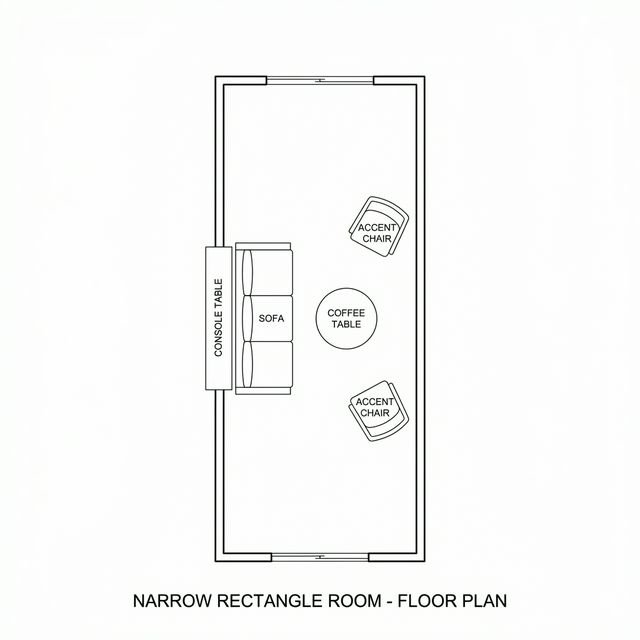
Layout 1 — The Narrow Rectangle
The challenge: Long and narrow — feels like a hallway with a couch in it.
The solution: Place your sofa perpendicular to the long wall, creating two distinct zones. Zone 1 is the seating area. Zone 2 is the entry path or secondary function (reading nook, workspace, dining).
Furniture placement:
- Loveseat or apartment-sized sofa (not a full-size) perpendicular to the long wall
- Narrow console table behind the sofa to “close” the zone
- 1-2 small accent chairs facing the sofa
- Coffee table between (round works better than rectangular in narrow rooms — no sharp corners to dodge)
Size guide: An apartment-sized sofa is typically 56-72 inches wide. A full sofa (84″+) will overwhelm this room shape. Measure before buying.
Pro tip: A long, narrow rug placed lengthwise along the sofa zone helps visually define the seating area without walls.
Layout 2 — The Small Square
The challenge: Everything feels equidistant and “same.” No focal point, no flow.
The solution: Anchor with an angled sofa to break the symmetry. In a square room, perfectly centered furniture makes everything feel static. An angle adds visual interest and creates a diagonal flow.
Furniture placement:
- 2-seater sofa at a slight angle (not straight against any wall)
- One accent chair placed at an angle to the sofa
- Round coffee table (moves better in square rooms than rectangular)
- One floor lamp in the far corner for depth
Why round: In a square room, round furniture breaks the “everything is a right angle” monotony. A round coffee table also lets people walk around it more easily.
Layout 3 — The L-Shape
The challenge: Dead corner, wasted space that collects clutter.
The solution: Place the sofa in the main run of the L, and transform the corner into a purpose zone — reading nook, plant corner, or mini workspace.
Furniture placement:
- Sofa along the longer wall of the L
- Coffee table in front, pulled toward center
- L corner becomes: reading chair + small side table + lamp, OR a tall plant + bookshelf, OR a small desk
The key insight: The L creates a natural nook. Instead of fighting it, lean into it. A single chair and lamp in that corner turns “dead space” into “cozy reading spot.”
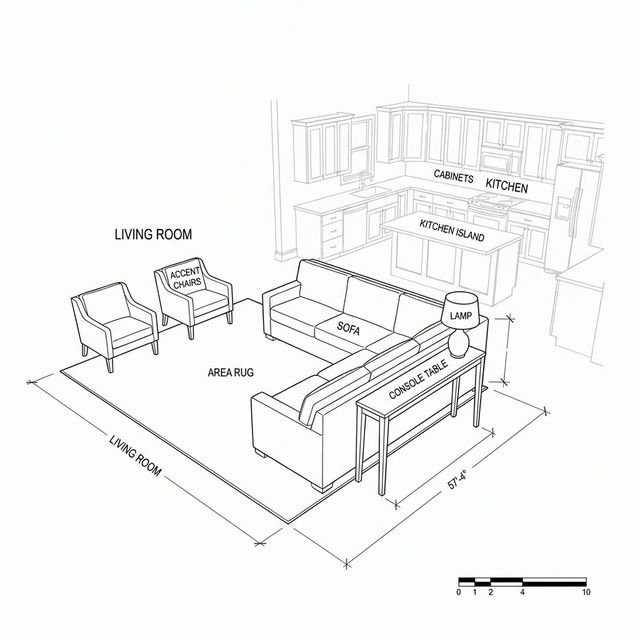
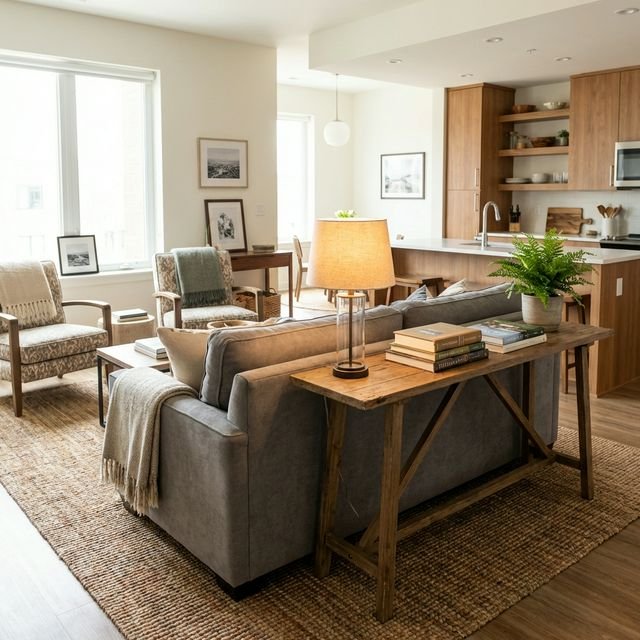
Layout 4 — Open-Plan Living + Kitchen
The challenge: No natural separation between living room and kitchen. The space feels like one big undefined blob.
The solution: Use the sofa back as a room divider. Place the sofa facing AWAY from the kitchen, with a console or narrow table behind it. This creates a visual wall without adding an actual wall.
Furniture placement:
- Sofa with its back toward the kitchen area
- Narrow console or sofa table behind it (holds a lamp, books, or plants)
- Coffee table in front, two chairs or poufs opposite
- Rug underneath the seating area to visually “claim” the zone
Bonus: The console behind the sofa does triple duty — it separates the rooms, provides surface space, and holds a table lamp for ambient lighting.
If you’re working with a tight budget, this layout requires zero new purchases — just repositioning what you already have.
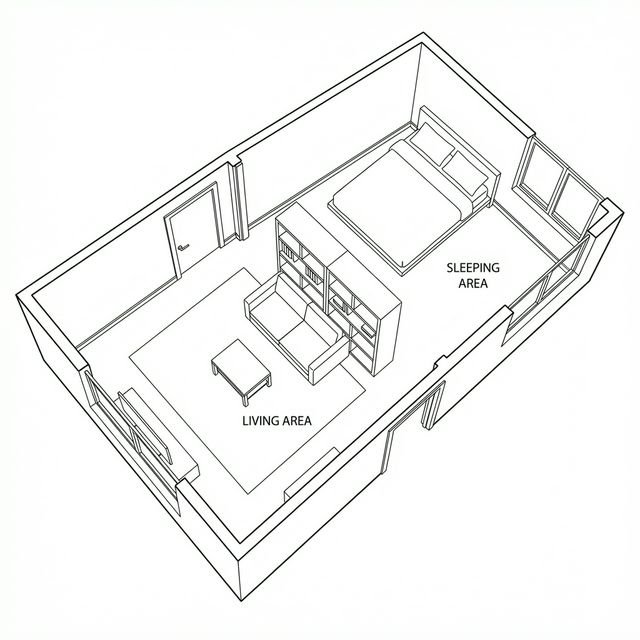
Layout 5 — Studio Apartment Living Area
The challenge: Your living room IS your bedroom. One room needs to do everything.
The solution: Zone with rug placement and a bookshelf divider. A low bookshelf (3-4 shelves) or open shelving unit creates visual separation without blocking light.
Furniture placement:
- Bed against one wall (ideally the one farthest from the entry)
- Open bookshelf perpendicular to the wall, acting as divider
- Sofa or loveseat facing away from the bed area
- Small coffee table or ottoman (dual-purpose — storage inside)
- Rug under the “living room” zone only — the rug edge IS the room divider
Layout 6 — The Alcove / Nook Room
The challenge: Awkward nook that collects clutter and feels like a mistake.
The solution: Turn the nook into the best part of the room. Reading corner, plant wall, or mini home office.
Furniture placement:
- Main seating arrangement in the open portion (standard sofa + coffee table)
- Nook becomes: armchair + floor lamp + small side table (reading corner), OR desk + chair (micro office), OR floating shelves + plants (green corner)
Why it works: When a nook has a clear purpose, it goes from “awkward dead space” to “I wish I had one of those.” It’s all about intention.
Layout 7 — Awkward Angles
The challenge: Non-rectangular walls, odd corners, diagonal elements that make standard furniture placement impossible.
The solution: Embrace asymmetry and use round furniture in weird corners. A round side table fits anywhere. A circular ottoman softens an awkward angle. Stop trying to force rectangular pieces into non-rectangular spaces.
Furniture placement:
- Largest piece (sofa) against the straightest wall
- Round coffee table in center — adapts to any room shape
- Accent chairs placed to work WITH the angles, not against them
- Floor lamp or tall plant in the pointy corner (which is almost impossible to furnish with anything else)
Layout 8 — Living Room with Fireplace
The challenge: The fireplace dictates furniture placement AND creates a TV-position dilemma.
The solution: Choose ONE orientation — face the fireplace OR face the TV. Never try to serve both at equal priority.
Option A — Fireplace focus:
- Sofa facing the fireplace
- Two chairs flanking the fireplace at angles
- TV on a swivel mount to the side (or no TV in this room)
Option B — TV focus:
- TV above the fireplace (controversial but common) or on the perpendicular wall
- Sofa facing the TV
- Coffee table between, chairs to the sides
The mistake to avoid: Placing the sofa halfway between TV and fireplace, facing neither properly. Pick a focal point and commit.
Furniture Scale Guide — What Actually Fits in Small Rooms
The #1 reason small living rooms feel cramped: oversized furniture. Here’s what actually fits:
| Room Size | Sofa Max | Coffee Table | Side Tables | Chairs |
|---|---|---|---|---|
| Under 100 sq ft | Loveseat (56″) | Round 24-30″ | 1 small | 0-1 accent |
| 100-150 sq ft | Apartment sofa (72″) | Rectangle 36-42″ | 1-2 | 1 accent |
| 150-200 sq ft | Mid-size sofa (80″) | Rectangle 42-48″ | 2 | 1-2 accent |
| 200+ sq ft | Full sofa (84″+) or sectional | Any shape | 2 | 2+ accent |
The test: Stand in the middle of your room. Can you walk from one side to the other without turning sideways? If not, something is too big.
📌 Save this table — bring it when furniture shopping so you don’t buy a sofa that’s 12 inches too long (the most common mistake).
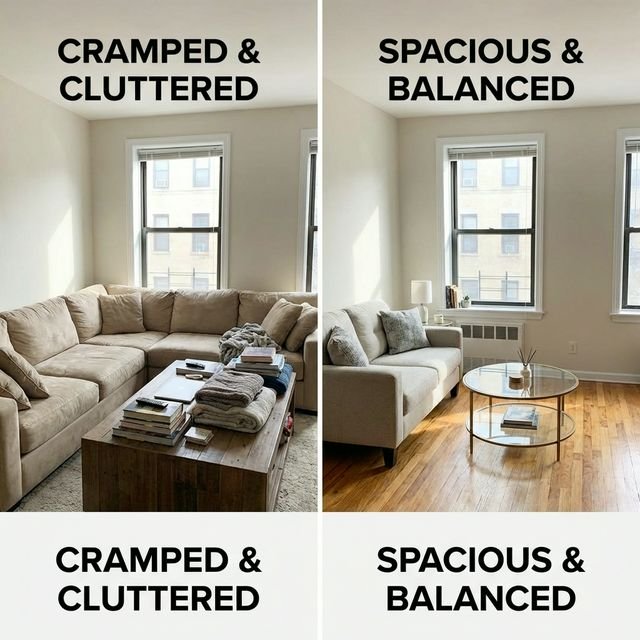
Once your layout is set and your furniture fits, you can layer in refresh touches to make the space feel complete.
7 Layout Mistakes That Make Small Rooms Feel Smaller
Avoid these — they’re the most common problems we see:
- Pushing ALL furniture against walls. Floating furniture creates depth illusion.
- Using a too-big coffee table. It should be about ⅔ the length of your sofa.
- Blocking pathways. You need at least 30″ of clear walking space.
- Too many small pieces. Fewer, right-sized pieces look better than lots of tiny ones.
- Ignoring vertical space. A tall bookshelf is better than a wide one in a small room.
- Wrong-size rug (or no rug). Your rug should be bigger than you think — front legs of ALL seating should be on it.
- Symmetry obsession. Asymmetry creates visual interest and feels dynamic in small spaces.
Frequently Asked Questions
How do I arrange furniture in a small living room?
Start with the 3 golden rules: float furniture away from walls, create a defined seating zone (not a ring of chairs around the perimeter), and choose pieces with visible legs. Then find your room shape above and use the matching floor plan as a starting point.
What is the best layout for a narrow living room?
Place the sofa perpendicular to the long wall to break the “hallway” feeling and create two zones. Use a round coffee table (easier to walk around) and keep furniture to apartment-sized proportions — a loveseat (56-72″) instead of a full sofa (84″+).
Should you put a sofa against the wall in a small room?
No — even though it seems logical. Pulling the sofa even 3-6 inches from the wall creates visual depth and makes the room feel more intentional. The small gap tricks the eye into seeing more space, not less.
What size rug for a small living room?
Bigger than you think. The front legs of all your seating furniture should be on the rug. For most small living rooms, a 5×7 or 6×9 works well. A rug that’s too small makes the room look smaller — it creates a visual “island” effect.
How do I make my living room feel bigger?
The top 5 tricks: float furniture off walls, use pieces with visible legs, add a mirror to reflect light, choose a round coffee table (fewer visual hard edges), and use vertical storage (tall bookshelf vs. wide). None of these cost much, and most are just rearranging what you already have.
What to Read Next
- 📖 Cozy living room ideas on a budget — add warmth without clutter
- 📖 Living room refresh checklist — 15 steps under $200
- 📖 Budget home makeover under $500 — room by room
- 📖 Home decor trends 2026 — what’s worth trying
📌 Pin these floor plans for your next room rearrangement!